The simple explanation
Unlike LSA 1, not every router gets to create an LSA 2. For that, you need a very specific job: you have to be the Designated Router, or the DR, on a multi-access network.
The technical explanation
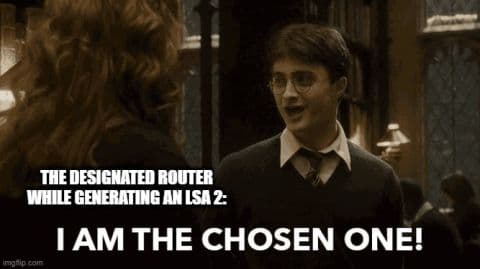
So naturally, LSA 2 is The Chosen One. He actually gets elected to be the DR. But why do we even need a DR?
Imagine several OSPF routers connected to the same shared network. If every router had to form a full adjacency with every other router, we would end up with a lot of adjacencies and a lot of OSPF traffic.
Instead, OSPF elects a Designated Router (DR) and a Backup Designated Router (BDR). The other routers form full adjacencies with the DR and BDR, which makes the whole thing a little less chaotic. And being The Chosen One comes with responsibilities.
The DR generates the Type 2 LSA, also called a Network LSA. It describes the shared network and tells OSPF which routers are connected to that network. So while LSA 1 is standing in the corner singing “Me, Myself & I”, LSA 2 proudly sings “The One and Only.”
There is one important thing to remember though: being the DR does NOT mean that normal network traffic has to pass through it. The DR has a special role in how OSPF exchanges information. It is not suddenly everyone’s gateway.
And just like Type 1, Type 2 LSAs stay inside their area.
So if you only remember three things about LSA 2:
- It is generated by the DR on a multi-access network.
- It describes the shared network and the OSPF routers connected to it.
- It stays inside the area.
The Chosen One. The important and elected one with great responsibilities and it's own sidekick, ready to take over.
Protocol reference: RFC 2328 (OSPFv2). NSSA reference: RFC 3101.
logic
"Only I can make the LSA 2 since I am the Chosen one"
Example
On a shared Ethernet network, OSPF uses a DR and a Type 2 LSA. On a point-to-point link, it does not need either.