A little OSPF story...
OSPF explained with dating, gossip, Mr. Krabs and memes. We go from Hello packets and neighbors to LSA1, LSA2, cost and classless routing. Because apparently this is how my brain remembers networking. Enjoy <3
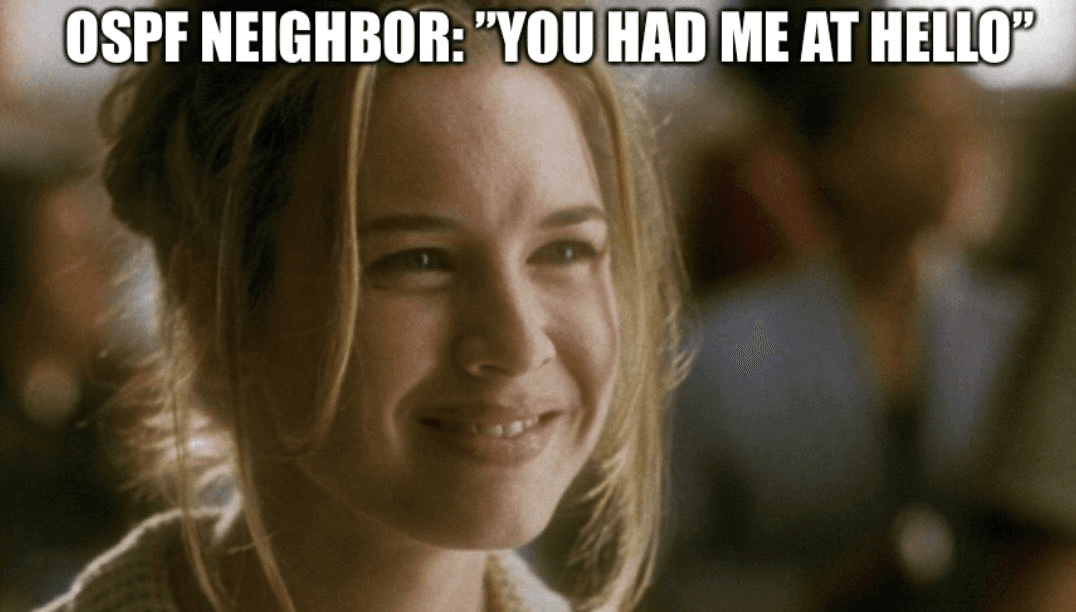
Hello. (see what I did there?) I'm here to talk about OSPF again.
At this point I've probably become that person who somehow manages to bring OSPF into every conversation. Networking. OSPF. Memes. OSPF. Dating? Surprisingly, also OSPF.
So instead of fighting it, let's embrace it. Let's tell a little OSPF story.
Chapter 1. Hello there!
Every relationship has to start somewhere. For OSPF routers, it starts with a simple Hello.
Not only because OSPF is polite, but becouse they're checking if the other router is relationship material.
They compare things like:
- Area ID
- Hello and Dead timers
- Authentication
- Stub flags
- Network type
- Subnet
If even one important thing doesn't match: Sorry. It's not you. It's your configuration. And that's exactly why I keep comparing OSPF to dating.
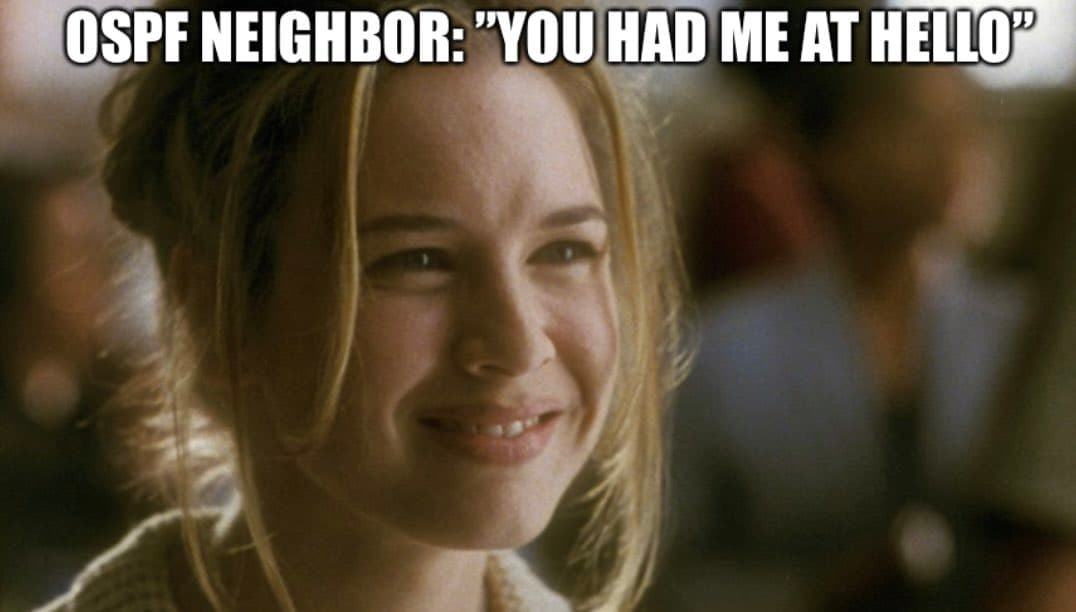
Once the Hellos look promising things get serious. The routers exchange database description packets, almost like introducing themselves.
After that comes Link State Requests and Link State Updates. Basically:
Here's everything I know about the network, let's share!
If everything checks out, they finally become Full Neighbors and keep synchronized Link State Databases.
It's networking's version of moving in together. Don't you think?
Chapter 2, Everyone has a story
Now that they're friends, they start talking. Not random gossip. Structured gossip (yes there's such a thing).
OSPF uses Link State Advertisements, or LSAs, to describe the network. The most common one is LSA Type 1, also called a Router LSA.
Every router creates one. And every router only talks about, well, itself. Its own interfaces. Its own links. Its own costs. Its own point of view.
Which is exactly why I couldn't resist making this meme back in the day.

If someone is "such an LSA1," they're basically saying:
" Let's talk about me, myself and I"
You'll probably never forget Router LSAs now. Most of us know a LSA1 IRL. Am I right?
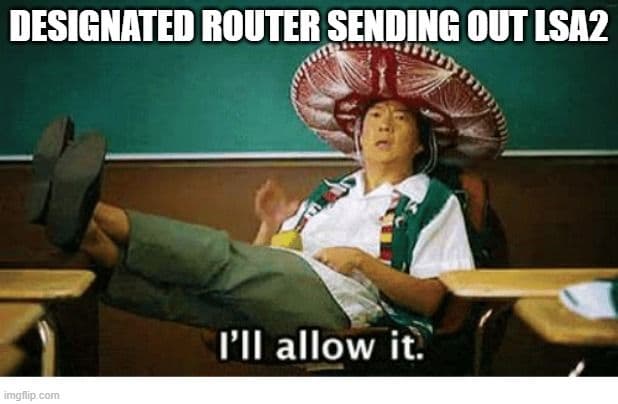
But not every LSA is that self-centered. On Ethernet networks, the Designated Router (DR) creates the LSA Type 2, the Network LSA.
Instead of talking about itself, it creates a group photo.
It tells everyone:
"These routers all belong to the same shared network."
Think of it like this:
- LSA1 = everyone's personal profile.
- LSA2 = the class photo.
Together they allow every router to build the complete topology. And because only the DR is allowed to create the Network LSA:
Chapter 3, OSPF is cheap
Now comes my favorite part. You all know what it is. Routing ofc!
People often think OSPF finds the shortest path. I mean, Open Shortest Path First, might make you think that. But not exactly.
It finds the cheapest path. And cheap is all OSPF really cares about. Let's call it one of the seven deadly sins. Greed.
If OSPF were a cartoon character, it would absolutely be Mr. Krabs.
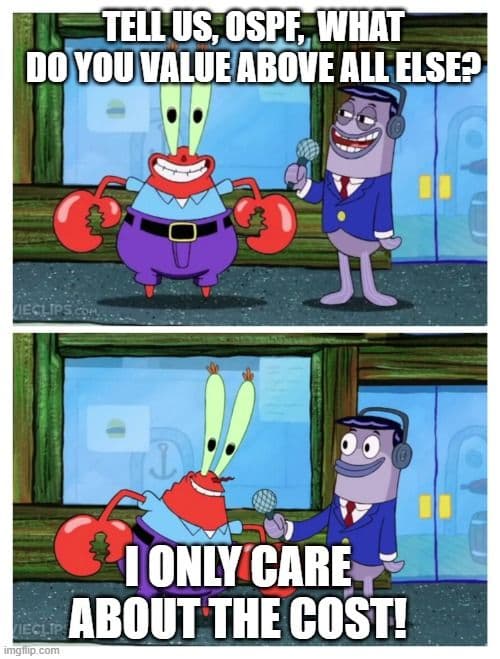
OSPF calculates cost using this formula:
Cost = Reference Bandwidth / Interface Bandwidth
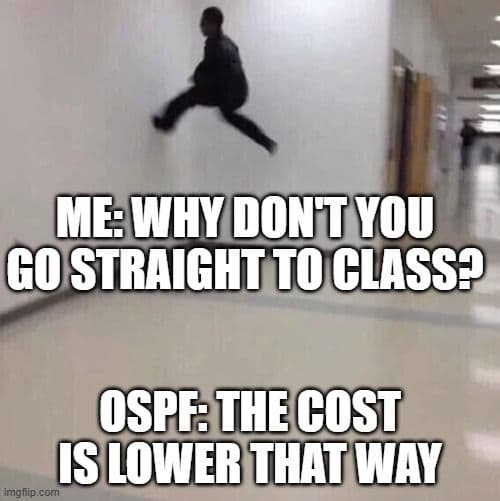
It doesn't care how many meters the cable is. It doesn't care about latency. It doesn't care if one path has more hops. Only the total cost matters.
Which explains why OSPF sometimes looks like it's parkouring through hallways instead of walking straight.
There's one tiny problem though. Cisco's default reference bandwidth is only 100 Mbps.
That means:
- 100 Mbps = Cost 1
- 1 Gbps = Cost 1
- 10 Gbps = Cost 1
- 100 Gbps = Cost 1
Oops.
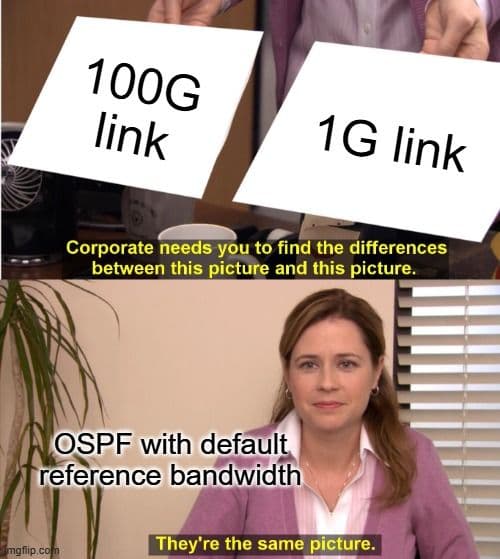
The calculation actually produces decimal values but OSPF costs must be whole numbers and can never be lower than 1. So everything faster than 100 Mbps ends up looking exactly the same.
The fix is simple. Increase the reference bandwidth. For example, using 100000 lets OSPF distinguish between 1G, 10G and 100G links.
Just remember one very important thing:
Every router in the OSPF domain must use the same reference bandwidth.
Otherwise everyone calculates different costs and routing decisions can become interesting.
Chapter 4, OSPF has no class (what so ever!!)
There's one last thing I'd like to clear up before we finish. Someone once accused OSPF of having no class.
Well, sure, they're absolutely right.
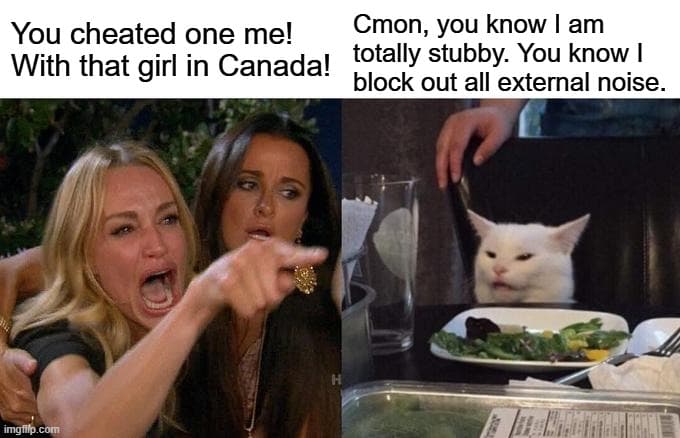
OSPF is a classless routing protocol, meaning it carries the subnet mask (prefix length) together with every route. Unlike older classful protocols it doesn't asume networks belong to fixed classes like A, B or C.
Why is this importent? Well, this allows OSPF to support both VLSM (Variable Length Subnet Masking) and CIDR (Classless Inter Domain Routing) and making it possible to use different subnet sizes throughout the same network.
In other words, OSPF doesn't care if a subnet is a /24, /27 or /30. It simply learns the correct prefix and routes accordingly.
That's one of the reasons OSPF has aged so well. It was designed for modern IP networking and doesn't carry around the limitations of the old classful world.
So the next time someone says OSPF has no class, Just smile and say:
"Of course not. It's classless."
Final thoughts
I know what ya'll thinking.I keep talking about OSPF. Probably more than any reasonable person should.
But honestly, I think that's why I enjoy teaching it so much. The protocol is full of little rules that can feel overwhelming at first.
Yet once you attach a funny story, a silly analogy or a meme to them, they suddenly become much easier to remember. And so much more relatable.
If this article makes you think of dating when you troubleshoot adjacencies, Mr Krabs when you calculate cost or an offended cat every time someone mentions "classful" routing,
Then my job here is done. ❤️